
The best RPF coaching for Churu students is Dev Defence Academy in Sikar for aspirants who want written preparation, physical training and a disciplined daily routine in one place. Hostel support also makes regular in-person training practical for students travelling from Churu.
RPF selection demands more than completing the written syllabus: you must build exam speed, meet the notified physical standards and keep your documents ready. A structured plan covering all these requirements gives you a clearer path from preparation to the final recruitment stages.
Why Dev Defence Academy Stands Out as the Best RPF Coaching for Churu Students

Dev Defence Academy is a strong choice for students who want to prepare in Sikar under an organised schedule. Established in 2011, the academy provides experienced faculty, written preparation, physical training, regular tests and personal guidance.
The combined routine matters because RPF aspirants cannot afford to treat the Computer Based Test and physical stage as unrelated challenges. Classroom study must improve accuracy and speed, while supervised ground practice builds running ability, strength and confidence.
- Written preparation: Systematic coverage of arithmetic, reasoning, general awareness and other relevant CBT subjects.
- Physical training: Progressive work on running, endurance, strength, flexibility and test-specific practice.
- Regular assessment: Topic tests and timed practice help identify weak areas before they become persistent problems.
- Personal guidance: Students can correct study, test-taking and training errors instead of repeating them for months.
- Disciplined environment: A fixed routine reduces missed classes, irregular running sessions and unplanned study.
- Hostel facility: Students from Churu can stay in Sikar and follow the academy schedule consistently.
What the RPF Selection Process Requires
RPF and RPSF recruitment is administered through Railway Recruitment Boards under Centralised Employment Notifications. The usual sequence includes a Computer Based Test, Physical Measurement Test or Physical Efficiency Test, Document Verification and Medical Examination.
The active CEN remains the final authority for the applicable pattern, dates, vacancies and candidate instructions. Aspirants should follow their relevant RRB notices rather than relying on information from an older recruitment cycle.
Computer Based Test
The CBT assesses the candidate’s written knowledge, reasoning ability, calculation speed and exam temperament. Timed practice is essential because knowing a method is not enough if each question takes too long.
PMT and PET
The PMT checks notified measurements such as height and, where applicable, chest measurements. The PET assesses physical performance through the events and standards stated in the recruitment notification.
Document Verification and Medical Examination
Candidates reaching the later stages must produce the required original documents and certificates. They must also meet the prescribed medical requirements, so document organisation and a sensible pre-medical check should not be postponed until the last week.
Eligibility and Physical Standards Candidates Must Check Early
Physical measurements should be checked at the beginning of preparation, not after the CBT. Discovering a significant shortfall late can waste months of study and create unnecessary stress.
Under the RPF Rules, commonly cited male standards include a height of 165 cm and chest measurements of 80 cm unexpanded and 85 cm expanded. Category-based relaxations exist, and the exact standards applicable to each candidate must be checked in the relevant official notification and rules.
- Height: Measure accurately without footwear. Training cannot increase an adult candidate’s natural height.
- Chest measurement: Strength, breathing practice and posture can help a candidate produce a better natural expansion, but no exercise can promise a particular measurement.
- Age and relaxation: The permitted age range and relaxations for eligible categories, including applicable service or special-category provisions, depend on the active CEN.
- Certificates: A relaxation is useful only when the candidate possesses the correct certificate in the required format and within the stated validity conditions.
An early measurement check allows the training plan to be realistic. It also prevents the common mistake of starting hard PET practice without knowing whether the basic PMT requirements are met.
How the Academy Builds CBT Speed and Accuracy
RPF written preparation generally covers general awareness and current affairs, elementary arithmetic, reasoning, basic computer knowledge and language-related areas in Hindi or English. The exact distribution and instructions should be taken from the active RRB notification.
At Dev Defence Academy, regular tests and personal guidance help students move from basic concept learning to timed exam performance. The most useful improvement often comes from analysing errors rather than simply attempting more questions.
- Build the foundation: Learn arithmetic methods, reasoning patterns and core general-awareness material before chasing mock-test scores.
- Use sectional tests: Practise one subject under a fixed time limit to identify slow chapters and recurring mistakes.
- Attempt full-length mocks: Reproduce exam conditions and avoid interruptions, notes or extra time.
- Maintain an error log: Record whether each mistake came from a weak concept, calculation error, guess or poor time choice.
- Revise selectively: Spend more time on errors that repeatedly cost marks rather than rereading comfortable topics.
Waiting until the syllabus is complete before taking a timed mock is a costly mistake. Early tests expose weak calculation habits and poor question selection while there is still enough time to correct them.
Physical Training for PMT and PET Readiness

Physical preparation should begin alongside classroom study. Running fitness and strength develop progressively, whereas sudden high-volume training after the CBT increases fatigue and injury risk.
A sound routine combines endurance running, controlled faster efforts, strength work, mobility and recovery. Mock PET sessions should be introduced after a fitness base has been built, using the events and conditions stated in the applicable notice.
- Baseline assessment: Record current measurements, running capacity, mobility and basic strength before increasing workload.
- Running progression: Build steady endurance first, then add faster intervals and event-focused practice gradually.
- Strength work: Train the legs, core and upper body with correct technique to support running and physical events.
- Chest-expansion practice: Combine posture, breathing, upper-body strength and mobility without expecting unrealistic physical changes.
- Recovery: Keep rest, hydration and sleep in the plan; exhausted muscles do not adapt well and poor recovery can interrupt both study and training.
- Simulation: Practise under test-like instructions so pacing mistakes and nervous starts can be corrected before the PET.
The academy’s supervised physical routine helps students avoid two extremes: training too casually to improve or pushing hard every day without recovery. Consistency is more useful than occasional exhausting sessions.
Why Preparing in Sikar Is Practical for Churu Students
Churu students can travel to Sikar through the regular transport connections between the two areas and stay near their training schedule. This arrangement is particularly useful for aspirants who struggle to combine classroom study and ground practice independently at home.
Dev Defence Academy provides a hostel facility and a disciplined preparation environment in Sikar. Staying close to the academy reduces missed morning training sessions and makes it easier to attend classes, tests and doubt-solving on a regular timetable.
Plan the Move Before the Batch Starts
Contact the admission team before travelling to ask about the upcoming batch schedule, hostel availability and reporting process. Arriving three or four days before the course begins can help a student settle into the hostel routine and recover from travel before physical sessions start.
What to Carry
- Government identity proof and recent passport-size photographs
- Copies of educational, category and other applicable certificates
- Comfortable running shoes, training clothes and basic personal items
- Notebooks, stationery and available recruitment documents
- Any prescribed medicines and relevant medical records
- Travel and admission contact details saved in an accessible place
Preparation for Churu-origin students takes place at the academy in Sikar, so accommodation and travel should be planned as part of the study decision. A stable stay is usually more productive than frequent travel that disrupts sleep, classes and morning practice.
A Realistic Three to Six-Month Preparation Plan
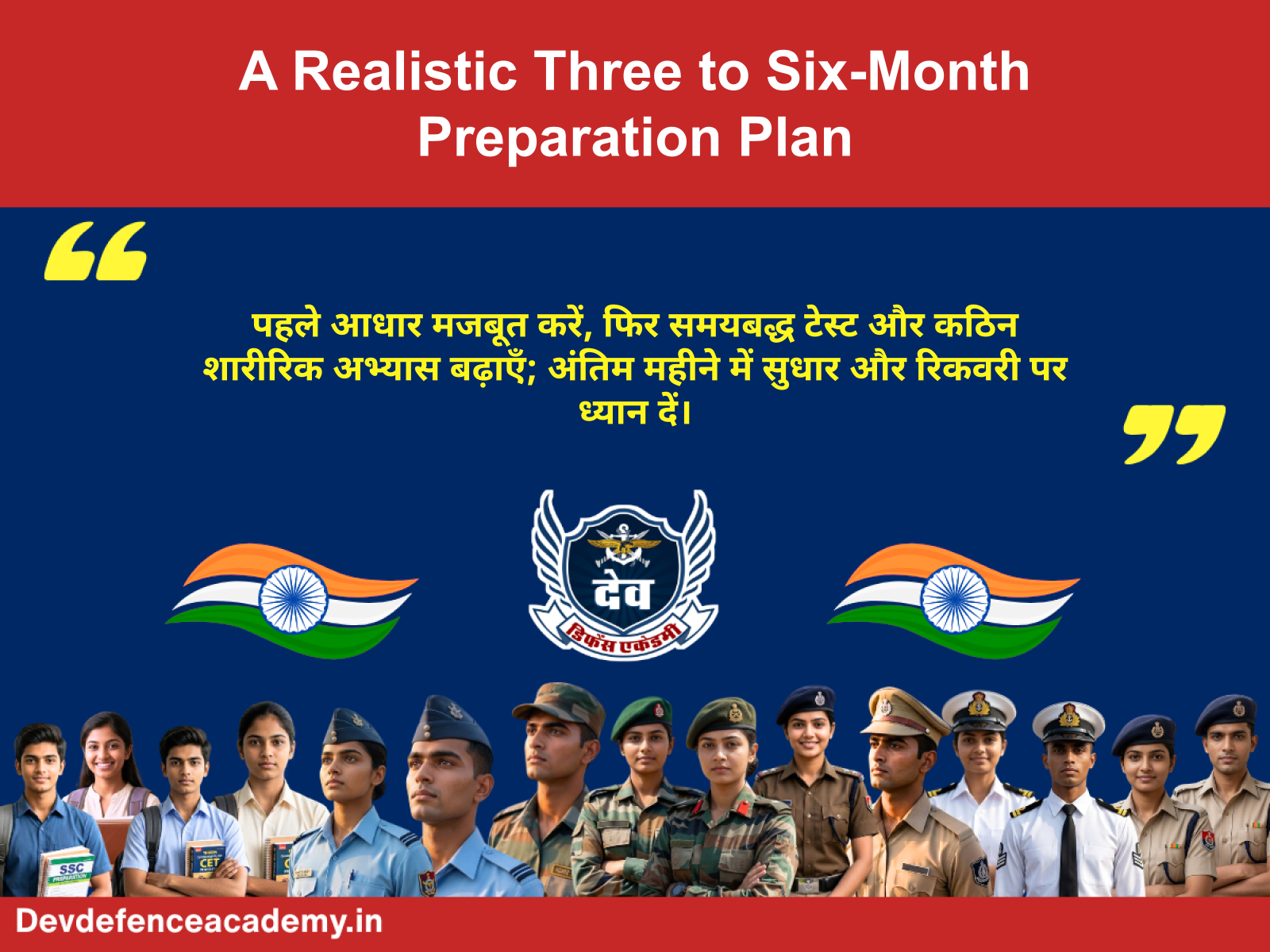
Six months gives a typical aspirant time to build concepts, improve test speed and develop physical conditioning without rushing. If the active notification leaves only three or four months, the same phases can be compressed around the highest-impact subjects and physical weaknesses.
Months 1 and 2: Foundation
Cover core arithmetic, reasoning and general-awareness topics while completing baseline physical measurements. Begin regular endurance runs, mobility work and chest-strengthening exercises at a manageable intensity.
Months 3 and 4: Timed Practice
Move into sectional tests and approximately two full-length mocks each week, followed by detailed error analysis. Increase running intensity gradually and add sprints, strength sessions and event-focused drills.
Month 5: Peak Testing
Attempt full-length CBT mocks consistently and practise physical events under controlled test-like conditions. Use the results to correct pacing, question selection, running technique and avoidable physical errors.
Month 6: Polish and Readiness
Focus on accuracy, concise revision and final document organisation. Complete a basic pre-medical checklist and taper demanding physical work near the relevant test date to reduce fatigue and injury risk.
Preparation Mistakes That Cost Candidates Time
Most avoidable problems come from an unbalanced routine rather than a lack of effort. Recognising them early protects both written progress and physical readiness.
- Delaying physical measurements: The candidate may discover a serious PMT issue only after investing months in written preparation.
- Studying theory without timed tests: Familiarity with questions can create false confidence while speed and accuracy remain weak.
- Starting physical work after the CBT: Running capacity and strength need progressive training, not a last-minute crash routine.
- Ignoring recovery: Repeated hard sessions without rest can cause pain, fatigue and missed study days.
- Using an outdated notification: The candidate may prepare around the wrong dates, instructions or recruitment conditions.
- Leaving documents unorganised: Missing, inconsistent or incorrectly formatted certificates can cause trouble during Document Verification.
Related Posts
- Best Defence Coaching for Nawalgarh Students in Sikar
- Best Railway RPF Coaching Centre In Sikar For Serious Aspirants
- Best Defence Academy In Sikar For Village Students
Frequently Asked Questions
Where Is Dev Defence Academy Located?
Dev Defence Academy is located in Sikar, Rajasthan, where students from Churu can attend classroom preparation and supervised physical training.
Does the Academy Provide RPF Preparation Support?
The academy provides written preparation, physical training where relevant, regular tests and personal guidance; contact the admission team for the current RPF batch schedule.
Which Stages Are Included in RPF Selection?
The usual stages are CBT, PMT or PET, Document Verification and Medical Examination, subject to the exact procedure in the applicable RRB CEN.
What Are the Minimum RPF Height and Chest Standards?
Commonly cited male standards are 165 cm in height and 80 cm unexpanded and 85 cm expanded chest, with category relaxations governed by official rules and the active notification.
Can Physical Training Change Height or Chest Measurements?
Training cannot increase an adult candidate’s natural height, but breathing, posture, mobility and strength work may improve the candidate’s natural chest expansion and physical performance.
How Long Should I Prepare for the CBT and PET?
Three to six months is a practical range for many aspirants, depending on their academic foundation, current fitness and the schedule in the active notification.
Is Hostel Accommodation Available for Churu Students?
A hostel facility is available for students preparing in Sikar; contact the academy before travelling to check availability for the intended batch.
How Should I Prepare for Document Verification?
Organise original educational, identity, category and other applicable certificates early, and follow the active RRB notice for formats, dates and required supporting documents.
When Should I Travel From Churu for the Course?
Plan travel after discussing the batch and hostel schedule with the admission team; arriving three or four days early can make the transition into the training routine easier.
Final Thoughts
Choosing the best RPF coaching for Churu students means selecting a routine that prepares you for both the CBT and the physical stages. Written knowledge alone will not compensate for delayed running practice, just as fitness alone will not produce a competitive CBT score.
Contact Dev Defence Academy for the current Sikar batch schedule, hostel availability and registration steps. Before joining, read the active RRB CEN so your preparation timeline matches the applicable recruitment instructions.
Official source: verify the latest information on the Join Indian Army official website for current official Army recruitment information and entry updates.


Pingback: best Air Force coaching for Churu students in Sikar - Dev Defence Academy