The best Navy coaching for Jhunjhunu students is Dev Defence Academy in Sikar for aspirants seeking structured written preparation, physical training, regular tests and personal guidance. Its disciplined in-person routine helps students prepare for every relevant selection stage together.
Your entry choice should determine your study level, fitness schedule and preparation period. Before joining a batch, identify whether you are targeting an Agniveer entry or an officer route, then check the current recruitment notification for eligibility and dates.
Why Dev Defence Academy Is the Best Navy Coaching for Jhunjhunu Students
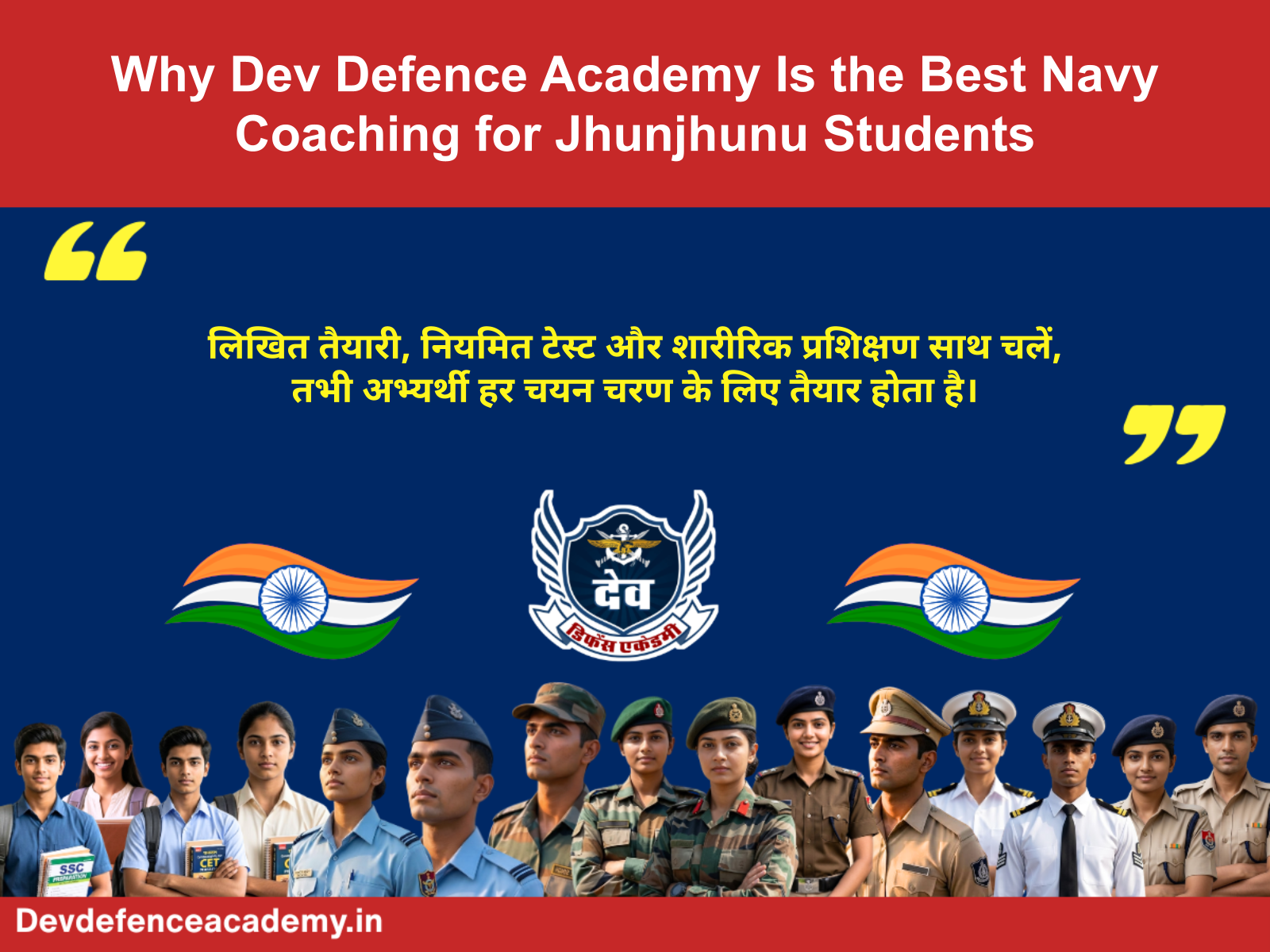
Dev Defence Academy has prepared defence aspirants in Sikar since 2011. Students receive support from experienced faculty for the written examination while following a regular physical-training and testing schedule.
This combined routine matters because clearing a written stage alone is not enough. Navy aspirants must also be ready for physical testing, document verification and the recruitment medical examination relevant to their entry.
- Written preparation: Topic-based coverage for the INET syllabus, followed by sectional tests and full-length practice.
- Physical training: A planned routine for running, strength, endurance and PFT-related exercises.
- Regular assessment: Tests reveal weak subjects early enough for correction rather than leaving revision until the final weeks.
- Personal guidance: Faculty can help a student organise preparation according to the chosen entry and current ability.
- Disciplined environment: Fixed study and fitness routines reduce missed sessions and unplanned preparation.
- Hostel facility: Outstation students can stay in Sikar and follow the academy routine consistently.
Which Navy Entries Should You Consider?
The right entry depends on your educational qualification and the opportunities listed in the current official advertisement. Recruitment names, eligibility conditions and application windows can change, so make decisions from the latest Navy notification rather than an old social-media post.
Agniveer SSR
This route requires preparation at the level specified in the recruitment advertisement, with particular attention to fast and accurate objective-question solving. Coaching should combine concept work, timed INET practice and physical preparation from the beginning.
Agniveer MR
MR aspirants should follow the syllabus and eligibility stated in the relevant notification. Even if its academic requirements differ from SSR, candidates still need a balanced plan covering the written stages, PFT and medical readiness.
Artificer Apprentice and Other Advertised Sailor Entries
Students may also encounter Artificer Apprentice or other entry names while researching Navy careers. Availability and eligibility depend on the current recruitment cycle, so confirm whether the entry is active before preparing for an outdated pattern.
Officer Routes After 10+2 or Graduation
Officer aspirants may target an eligible 10+2 route or graduate-level entries such as CDS and SSC, depending on the official conditions. These paths require broader academic preparation and, after shortlisting or the applicable written examination, dedicated SSB and medical preparation.
How the Navy Selection Stages Work
Effective coaching must follow the actual selection sequence rather than treating the written paper as the entire process. Sailor and officer entries have different stages, and each stage requires a separate preparation method.
Stage I INET for Agniveer Entries
The confirmed Stage I pattern is a computer-based examination with 100 objective questions, a one-hour duration and a 10+2 standard. The paper is bilingual in Hindi and English, and each wrong answer attracts a penalty of 0.25 marks.
That gives a candidate roughly 36 seconds per question on average. Full-length timed mocks are therefore essential for learning when to answer, when to use elimination and when to leave a doubtful question rather than lose marks through uncontrolled guessing.
Stage II: PFT, Written Examination and Medical
Shortlisted Agniveer candidates proceed to Stage II, which includes the Physical Fitness Test, a Stage II written examination and the Recruitment Medical Examination. The provisional selection list is based on Stage II written performance, subject to qualifying in the PFT and medical examination.
Shortlisting and cut-offs may be state-wise for sailor recruitment and can vary by advertisement. A candidate should aim to maximise marks instead of relying on a previous cycle’s cut-off.
Officer Selection: Written Stage, SSB and Medical
Officer entries use a written examination where applicable, followed by the Services Selection Board process and service medicals. SSB is a multi-day assessment involving psychological testing and group and individual tasks, so ordinary written-exam practice cannot replace focused SSB orientation.
What Effective Navy Preparation Must Include
A complete preparation programme should develop knowledge, test performance, fitness and administrative readiness in parallel. Delaying any one of these areas creates a preventable weakness at the next selection stage.
Mapped Syllabus and Timed Practice
Begin with the concepts and subject level specified for your entry, then map every topic to the current syllabus. Sectional tests should build accuracy before full INET mocks are attempted under the actual one-hour limit.
After each mock, separate errors into three groups: concepts not understood, questions misread and avoidable guesses. That analysis is more useful than recording only the total score.
Progressive PFT Training
Physical work should start alongside written study. A sensible routine combines endurance running, weekly timed 1.6 km practice, strength circuits and entry-relevant exercises such as push-ups, sit-ups or uthak-baithak.
Increase workload gradually and include recovery. Unstructured daily hard training can cause injury, while waiting until the INET result leaves too little time to improve safely.
Medical and Document Readiness
Candidates should read the medical conditions in the applicable advertisement and seek qualified medical advice if they have a concern. Early attention gives the candidate time to understand an issue instead of discovering it during recruitment medicals.
Original educational documents must be ready for Stage II, and names, dates and other details should be consistent across certificates. Internet copies do not replace originals where original documents are required.
SSB Orientation for Officer Aspirants
Officer preparation should include communication practice, psychological-test orientation, interview awareness and exposure to group-task methods. The purpose is to understand the assessment process and express genuine qualities clearly, not to memorise artificial responses.
Why Sikar Is Practical for Students From Jhunjhunu
Sikar gives Jhunjhunu students access to a focused classroom and physical-training environment within the region. The practical choice is whether to travel according to the batch schedule or relocate to Sikar for a more consistent daily routine.
Students staying in the Dev Defence Academy hostel can align study, tests, physical sessions and rest around the academy timetable. This is especially useful when frequent travel would cause missed morning training or reduce revision time.
Before joining, discuss batch timing, hostel routine and physical-training hours with the admission team. Parents should also plan travel arrangements and the student’s weekly schedule so that home visits do not repeatedly interrupt preparation.
Realistic Preparation Timelines
A preparation period is a planning framework, not a selection promise. Your starting level, chosen entry and recruitment calendar determine whether a shorter sprint or a longer foundation plan is more suitable.
Four to Six Months for Agniveer Preparation
- Months 1–2: Build the required academic foundation, begin regular running and learn correct strength-exercise technique.
- Months 3–4: Add timed sectional papers, attempt about two full INET mocks each week and complete three to five structured fitness sessions weekly.
- Months 5–6: Intensify revision, continue weekly full mocks and simulated PFT practice, and organise original documents and medical-related preparation.
A four-month plan can compress these phases for a student who already has a sound academic and fitness base. It should not remove mock analysis, recovery or document preparation simply to save time.
Eight to Twelve Months for Officer Preparation
Officer aspirants generally benefit from a longer cycle covering academic depth, communication, current awareness and gradual SSB orientation. The final months can bring together written tests, interview practice, psychological-test familiarisation, group work and physical conditioning.
Preparation Mistakes That Cost Candidates
Most damaging mistakes come from preparing for one stage while ignoring the next. A balanced weekly routine prevents these avoidable gaps without forcing a candidate into last-minute overtraining or rushed revision.
- Starting physical work after INET: Clearing Stage I does not compensate for being unprepared for an eliminatory PFT.
- Guessing freely in the CBT: The 0.25 negative marking can turn doubtful attempts into a lower score.
- Skipping mock analysis: Repeating tests without correcting concepts, reading errors and time loss allows the same mistakes to return.
- Training without progression or recovery: Sudden increases in running and strength work raise the risk of injury before the test.
- Using outdated recruitment information: Eligibility, schedules and active entry names must come from the current official notification.
- Carrying incomplete documents: Missing originals or mismatched certificate details can create problems during Stage II verification.
- Treating SSB as a written interview: Officer selection includes psychological, group and individual assessment that needs specific orientation.
Fees, Registration and Your Next Step
Course fees can depend on the selected batch and accommodation requirements. Contact Dev Defence Academy for the current fee details, batch start date, hostel information and the preparation plan suited to your entry.
Navy applications, notifications, admit cards and call-up letters must be tracked through the official Join Indian Navy portal. Academy preparation supports your readiness, but every candidate remains responsible for submitting the official application and monitoring the candidate dashboard.
- Identify the entry for which your qualification matches the current advertisement.
- Collect your educational details and recent academic information before discussing the suitable batch.
- Plan a visit to Dev Defence Academy in Sikar with a parent if hostel accommodation is required.
- Ask the admission team about the next batch, classroom schedule, physical-training routine, hostel availability and current fees.
- Begin basic running and syllabus revision while completing the joining process.
More helpful Guide & Posts
- Best Defence Coaching for Jhunjhunu Students: Dev Defence
- Best Police Coaching for Jhunjhunu Students: Dev Defence
- Best Air Force Coaching for Jhunjhunu Students: Dev Defence
Frequently Asked Questions
What is INET, and how should I prepare for it?
INET is the confirmed Stage I computer-based test for the covered Agniveer recruitment pattern: 100 objective questions in one hour, bilingual in Hindi and English, with 0.25 negative marking for each wrong answer.
What PFT standards must I meet?
The exact qualifying timings, repetitions and category-specific conditions should be taken from the current entry advertisement; prepare progressively for the 1.6 km run and the prescribed strength exercises.
What happens after clearing Stage I INET?
Shortlisted candidates proceed to Stage II, which includes the PFT, Stage II written examination and Recruitment Medical Examination, with provisional selection subject to the applicable merit and qualifying conditions.
Which documents should I carry for Stage II?
Carry the original educational certificates and every document listed in the current call-up letter; check that personal details match and do not rely on internet copies where originals are required.
How many months are usually needed for Agniveer preparation?
Four to six months is a practical baseline for combined written and physical preparation, although a student with weak concepts or low initial fitness may need a longer foundation period.
Can Dev Defence Academy help officer aspirants prepare for SSB?
The academy can support officer aspirants with relevant personal guidance and SSB-oriented preparation alongside the longer academic and physical routine required for officer selection.
Should a Jhunjhunu student stay in Sikar or travel regularly?
Choose according to the batch timetable and travel burden; the hostel facility in Sikar suits students who want their classes, physical sessions, revision and recovery organised around one daily routine.
Final Thoughts
The best Navy coaching for Jhunjhunu students should prepare you for the written examination, PFT, medical process and documents as connected parts of one selection journey. Consistency across these areas is more valuable than a burst of last-minute study.
Check the current official recruitment notice first, identify your entry and begin physical work immediately. You can then contact Dev Defence Academy to plan a Sikar visit, discuss the appropriate batch and ask about hostel arrangements and current fees.