Agniveer Medical Standards for Girls allow women to join the Army, Navy and Air Force in entries where female recruitment is advertised, provided they meet the notified height, weight, vision and medical requirements. The main height benchmarks are 152 cm for Agniveervayu, 157 cm for Navy Agniveer and typically 162 cm for Army Women Military Police.
These numbers are only the starting point: the final decision also considers vision, colour perception, body proportions, investigations, pregnancy status, tattoos and service-specific restrictions. Rajasthan candidates should read the notification for their exact entry before reporting because relaxations and supporting documents can differ.
Agniveer Medical Standards for Girls: Complete Service-Wise Guide

Women can be enrolled under Agnipath wherever the relevant Service advertises female vacancies. Medical fitness is assessed for military duties, not merely for passing a general health check.
The following comparison uses the published standards in the validated Army, Navy and Air Force recruitment notices. A later notification for your batch remains the final authority.
| Service and Entry | Minimum Height | Other Key Standards |
|---|---|---|
| Indian Air Force Agniveervayu | 152 cm for female candidates | Service-prescribed vision, physical measurements and medical investigations; notified regional height relaxations apply to eligible candidates from specified areas. |
| Indian Navy Agniveer SSR/MR | 157 cm for female candidates | Uncorrected vision 6/12, corrected vision 6/6 and qualifying colour perception. |
| Indian Army Agniveer GD, Women Military Police | Typically 162 cm | Weight proportionate to height and age under the official chart, plus 5 cm chest expansion. |
Indian Air Force Agniveervayu
The minimum female height is 152 cm. Regional relaxations are notified for eligible candidates from the North East, hilly areas of Uttarakhand and Lakshadweep, so proof of eligibility must accompany any relaxation claim.
Vision, prescription limits and prior refractive surgery are assessed under the current Agniveervayu notice. Candidates who wear spectacles should carry a recent prescription bearing the ophthalmologist’s date and registration details; the cited Air Force notice requires it to be recent, often within one month of the medical.
Indian Navy Agniveer SSR and MR
The published minimum height for female candidates is 157 cm. The stated visual standard is 6/12 without correction and 6/6 with correction, while colour perception must also be passed.
Spectacles do not by themselves establish eligibility or ineligibility. The measured power, corrected vision and every other condition in the entry notification determine the result.
Indian Army Women Military Police
Army Women Military Police notifications typically prescribe 162 cm minimum height, weight proportionate to height and age, and chest expansion of 5 cm. The recruiting staff use the official weight-for-height chart rather than a candidate’s estimate of an ideal weight.
Some tribal, North Eastern and hilly categories receive notified regional relaxations. A candidate claiming one must carry the required domicile or category evidence; place of residence alone does not establish entitlement.
What the Medical Examination Checks

The medical board looks for the ability to train, work and remain deployable under military conditions. A candidate may feel healthy yet be referred or declared unfit because a measured standard, investigation or document does not meet the notification.
Examination commonly covers the eyes, ears, nose and throat, teeth, skin, limbs, spine and major body systems. Doctors may also look for chronic illness, structural deformity or a condition likely to interfere with demanding duties.
Investigations and Female Pelvic Ultrasound
The Air Force baseline includes a blood haemogram, urine routine and microscopic examination, blood sugar, cholesterol, renal and liver function tests, chest X-ray and ECG. Female Agniveervayu candidates also undergo ultrasonography of the lower abdomen and pelvis.
A preliminary check at a competent government or large private hospital can identify treatable dental, ENT or routine health issues before reporting. It cannot replace the official medical board or guarantee a fit decision.
Vision, Colour Perception and Refractive Surgery
Vision is tested separately for each eye, with and without correction where applicable. Colour perception is also important, particularly where the notification expressly requires a qualifying result.
LASIK, PRK and other refractive procedures are governed by service- and entry-specific conditions; the limits are not identical across every recruitment. The Air Force notice includes restrictions, so disclose the procedure honestly and carry the available surgical and follow-up records.
Rules That Commonly Lead to Medical Rejection
Several rejection causes are unrelated to running performance or written marks. Understanding them early prevents a candidate from spending weeks preparing for the wrong standard or arriving without essential evidence.
Some conditions may lead to a temporary or appeal-stage review, while others conflict directly with the recruitment rules. Only the Service medical authorities can make that classification.
- Pregnancy: Pregnancy at reporting is disqualifying under the recruitment documents. Conceiving during the four-year engagement can lead to discharge under the stated terms.
- Gender reassignment: Candidates with gender reassignment surgery are declared unfit under the applicable recruitment rules.
- Tattoos: Only tattoos permitted by the relevant Service notice are acceptable. Rules cover location and category; a tattoo outside a permitted area, or an incorrect declaration, can end candidature.
- Vision problems: Uncorrectable vision, failure of colour perception where required, or a refractive procedure outside the notified conditions can result in unfitness.
- Orthopaedic or systemic conditions: Serious deformity, major organ disease and uncontrolled chronic conditions can be incompatible with military duty.
- Weight and measurements: Missing the official height, proportional-weight or chest-expansion requirement can lead to rejection even when general fitness appears good.
“Fit for duty anywhere” means being medically and physically capable of training and serving in different climates, locations and working conditions. The standard therefore considers future operational demands rather than only the candidate’s health on examination day.
Appeal Medical Board Process and Deadline
A finding of unfitness does not mean candidates should seek informal assurances or conceal the condition. Follow the written Appeal Medical Board procedure given at the medical centre and in the notification.
The available appeal window can be short. For the cited Agniveervayu recruitment, the candidate must apply within three working days of the medical examination and deposit the prescribed ₹40 fee through the stated MRO or e-MRO process.
- Collect the unfitness finding and note the condition recorded by the medical board.
- Complete the prescribed appeal form within the notified time.
- Pay the required fee through the method stated for that recruitment.
- Keep the payment record, medical documents, identification and call instructions ready.
- Report to the assigned Appeal Medical Board on the given date.
Army and Navy candidates must follow the appeal procedure and deadline in their own notice or medical documents; do not assume that the Air Force fee or timeline applies to every Service. Private reports may provide medical history, but they do not compel an appeal board to declare a candidate fit.
Pre-Medical Checklist for Rajasthan Candidates
Start with documents and measurable standards rather than last-minute remedies. Rajasthan candidates travelling to their reporting centre should keep originals organised separately from photocopies and check the instructions printed on the call letter.
Dev Defence Academy in Sikar helps defence aspirants follow relevant notifications, maintain a disciplined preparation routine and combine written preparation with physical training. Regular tests and personal guidance can also reduce errors caused by preparing under an outdated rule.
- Measure height accurately and compare weight with the current Service chart.
- Arrange an eye examination and obtain a current, signed spectacle prescription if applicable.
- Complete dental and ENT checks early enough to treat caries, infection or ear wax safely.
- Carry original education, identity, domicile and category documents required by the notice.
- Bring valid proof when claiming a regional height relaxation.
- Obtain a non-pregnancy certificate from the specified medical authority if the rally or recruitment notice asks for one.
- Declare tattoos and previous refractive surgery accurately, with supporting records where relevant.
- Follow any fasting, hydration or reporting instructions issued for blood tests or ultrasound.
- Do not take temporary medication merely to alter a measurement or test result; disclose current treatment to the examining doctor.
Common Mistakes and Their Consequences
Most avoidable problems come from stale paperwork, assumptions about relaxations or delayed treatment of minor conditions. The cost may be referral, an unfit finding or cancellation during verification.
Use the exact advertisement and call letter for your batch rather than screenshots or standards remembered from an older recruitment cycle.
- Old spectacle prescription: It may not satisfy the notification’s recency requirement and can delay corrected-vision verification.
- No relaxation proof: A lower height standard cannot be claimed without the specified domicile or category documents.
- Delayed dental or ENT check: Treatable caries, infection or impacted ear wax may cause an avoidable medical problem.
- Assuming every tattoo is acceptable: Permanent tattoos outside the locations or categories permitted by the Service can be disqualifying.
- Estimating weight informally: The official chart, height measurement and age category govern the assessment.
- Incorrect declarations: Misreporting measurements, surgery, tattoos or documents can lead to cancellation beyond the medical issue itself.
An 8–10 Week Medical Readiness Plan
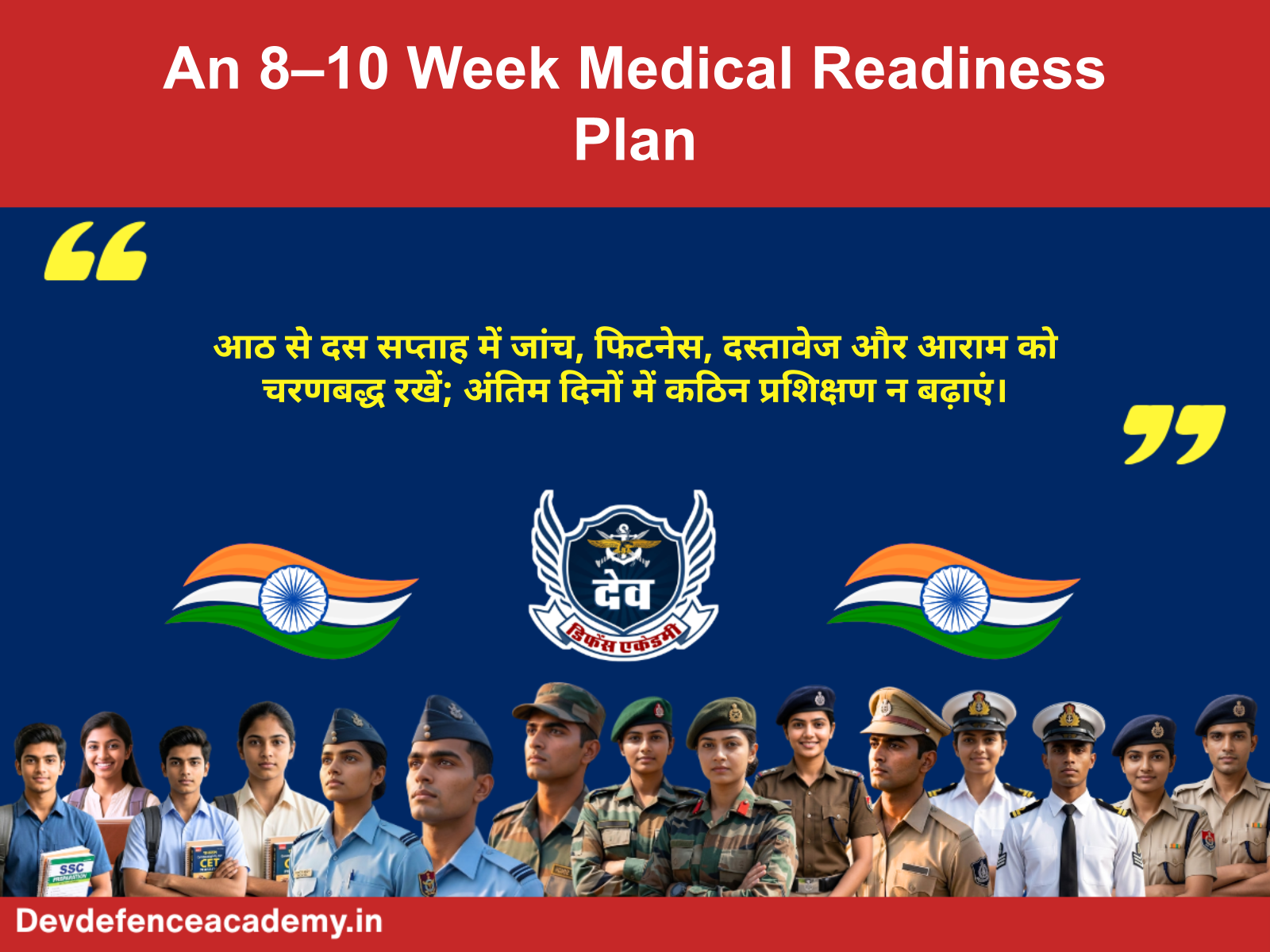
Medical preparation works best when checks happen early and fitness changes are gradual. Crash dieting, excessive running and last-minute treatment can create fatigue or injury just before reporting.
At Dev Defence Academy, students preparing in person in Sikar can follow a structured routine covering written work, physical training, regular tests and personal guidance. Hostel facilities are available where relevant for outstation students relocating to Sikar.
Related Posts
- Air Force Medical Standards for Girls: Complete Guide
- Navy Physical Standards for Girls: Complete Guide
- Air Force Physical Standards for Girls: Complete Guide
Weeks 1–2: Establish the Baseline
- Read the current entry notification and list every medical and document requirement.
- Check height, weight, vision, colour perception, dental health and ENT health.
- Complete routine blood and urine screening if advised by a qualified doctor.
- Organise domicile, education, identity and applicable category records.
Weeks 3–6: Build Fitness Gradually
- Use progressive running rather than sudden high-volume sessions.
- Adjust body weight steadily through sensible food intake and training.
- Practise diaphragmatic breathing and chest-expansion exercises without forcing the breath.
- Schedule recovery and address pain before it becomes an injury.
Weeks 7–8: Complete Remedial Work
- Finish advised dental or ENT treatment and attend follow-up appointments.
- Review vision findings and collect records of any previous eye surgery.
- Recheck measurements and practise the reporting-day document sequence.
Final 7–10 Days
- Collect a current spectacles prescription, ideally within one month of the medical where required.
- Obtain the non-pregnancy certificate if the specific notice requests it.
- Arrange originals, photocopies, photographs and call-letter documents.
- Reduce hard training, sleep properly and avoid experimenting with supplements or medicines.
- Confirm reporting time, location and travel arrangements.
Official Updates, Notifications and Call Letters
Medical standards can change by Service, entry and recruitment cycle. Check the complete advertisement rather than relying on a summary, especially for eyesight limits, refractive surgery, tattoos, relaxation categories and appeal instructions.
Air Force candidates should use the official Agniveervayu recruitment portal, Navy candidates should use Join Indian Navy, and Army candidates should use Join Indian Army. Sign in to the relevant candidate account and follow the published instructions to download the call letter when it is released.
Keep a saved copy of the advertisement and call letter on your phone, but carry printed copies wherever the reporting instructions require them. Any conflict between a general explanation and your current official notice must be resolved in favour of that notice.
Frequently Asked Questions
Can Girls Apply for Agniveer Across All Three Services?
Yes. Women can apply for Army, Navy and Air Force Agniveer entries where female recruitment is advertised and they meet the entry-specific eligibility and medical rules.
What Is the Minimum Height for Female Agniveer Candidates?
The published benchmarks are 152 cm for Agniveervayu, 157 cm for Navy Agniveer and typically 162 cm for Army Women Military Police, subject to notified regional relaxations.
Are Spectacles Allowed for Female Candidates?
Eligibility depends on the Service’s uncorrected and corrected vision limits, prescription and entry rules; Navy’s cited standard is 6/12 uncorrected and 6/6 corrected.
Does LASIK or PRK Automatically Disqualify a Candidate?
Not under one universal rule. Refractive surgery conditions differ by Service and entry, so check the current notice and disclose the procedure with medical records.
Will Pregnancy Lead to Disqualification?
Yes. Pregnancy at reporting is disqualifying, and the recruitment terms state that conceiving during the four-year engagement can lead to discharge.
Is a Pelvic Ultrasound Part of the Medical?
The cited Air Force notification includes ultrasonography of the lower abdomen and pelvis among the baseline investigations for female candidates.
How Does an Appeal Medical Board Work?
A medically unfit candidate applies through the notified procedure within the deadline; the cited Air Force process requires application within three working days and a ₹40 fee.
Are Tattoos Allowed?
Only tattoos meeting the relevant Service’s rules on permitted location and category are acceptable, so candidates must check the current notice and declare tattoos accurately.
How Strict Is the Army Weight Standard?
Army Women Military Police candidates are assessed against the official weight-for-height and age chart, not a self-calculated target weight or appearance.
Where Should Rajasthan Candidates Confirm the Final Standards?
Use the official Agniveervayu, Join Indian Navy or Join Indian Army portal and read the complete advertisement and call-letter instructions for your recruitment cycle.
Final Thoughts
Agniveer Medical Standards for Girls are strict but manageable when you check the correct entry early. Measure height and weight, arrange vision, dental and ENT examinations, and collect every supporting document before the reporting date.
Treat an 8–10 week plan as preparation, not a guarantee of medical fitness. For a disciplined written and physical routine, Rajasthan aspirants can connect with Dev Defence Academy in Sikar and prepare according to the latest applicable notification.