Eyesight requirement for defence exams is an important medical standard that every Army, Navy, and Air Force aspirant should understand before starting preparation.
A student may be strong in written exams and physical tests, but if the eyesight standard is not suitable for the chosen entry, the final selection can become difficult.
That is why smart preparation includes written study, physical fitness, and basic medical awareness from the beginning.
Many students prepare for months without checking their vision properly. Later, during the medical test, they feel confused about terms like 6/6 vision, colour vision, myopia, hypermetropia, and spectacles.
Dev Defence Academy in Sikar helps students prepare in a structured way with written classes, physical training, hostel facility, and disciplined routine, so aspirants can understand the full selection process more clearly.
The eyesight requirement for defence exams is not exactly the same for every force or every post.
Army, Navy, and Air Force have different medical expectations depending on the type of duty.
A flying branch candidate may need stricter eyesight than a ground duty candidate, while some Army entries may allow glasses within a certain limit.
Eyesight Requirement For Defence Exams Army Navy Air Force Standards
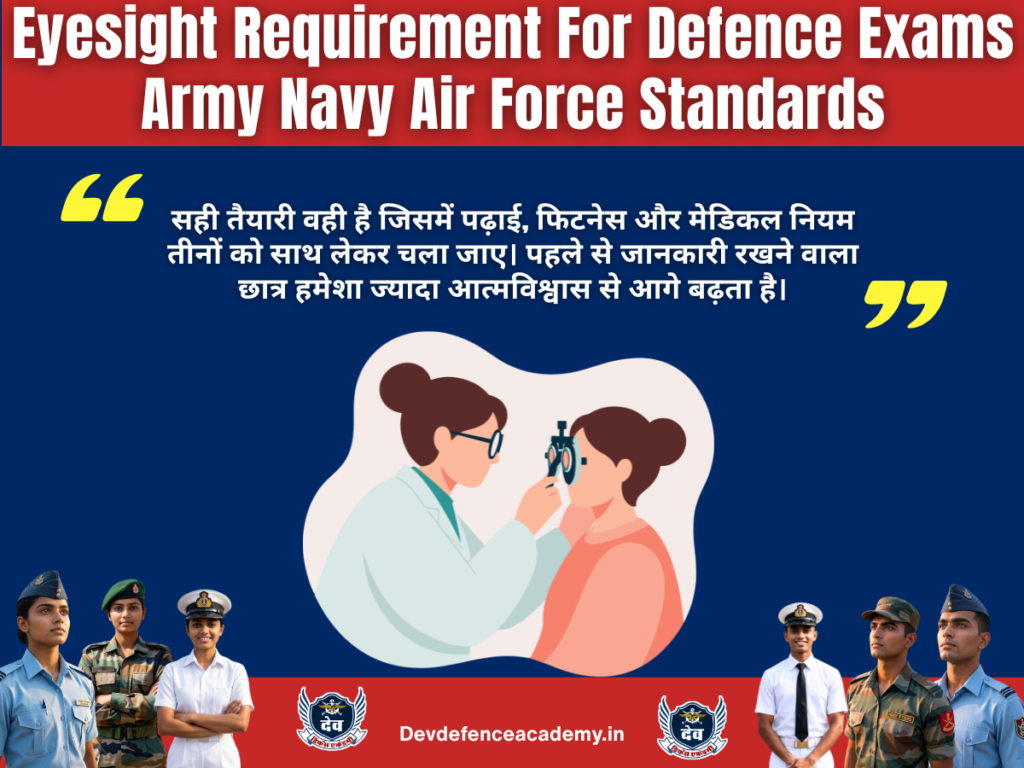
The eyesight requirement for defence exams Army Navy Air Force standards means the minimum visual fitness needed to join different defence services.
These standards help the medical board check whether a candidate can perform field duty, technical duty, sea duty, flying duty, or ground duty safely.
Students should understand one thing clearly: eyesight standards depend on the entry, branch, and job role.
NDA, CDS, AFCAT, Agniveer, Army GD, Navy SSR, and Air Force entries may not follow the same visual rules.
So, instead of depending on random advice, candidates should always check the latest official notification for their exact exam.
A common mistake is thinking that all defence jobs require perfect eyesight without glasses. This is not true for every entry.
Some roles allow corrected vision with spectacles, while some sensitive roles, especially flying-related roles, have stricter standards.
Read more:
- How To Improve 1600 Meter Running Time For Defence Exam
- Agniveer Selection Process Complete Guide For Students
- Best Army Nursing Assistant Coaching In Sikar
What 6/6, 6/9, And Corrected Vision Mean
Many students hear terms like 6/6 or 6/9 but do not understand them clearly. These numbers are used to measure how clearly a person can see from a certain distance.
In simple words, 6/6 vision is considered normal distance vision.
If your vision is 6/9, it means you can see at 6 meters what a person with normal vision can see at 9 meters.
This does not always mean rejection, because some entries allow corrected vision. Corrected vision means your eyesight after wearing spectacles or contact lenses.
Uncorrected vision means your natural eyesight without glasses. Defence medical standards may mention both corrected and uncorrected vision.
This is why students should not only ask “Are glasses allowed?” but also check the allowed power limit for their specific entry.
Army Eyesight Requirement For Defence Exams
The Indian Army requires candidates to have healthy eyesight because Army duty often includes field movement, weapon handling, map reading, night movement, and outdoor tasks.
However, Army eyesight standards may vary according to the post and category.
For many soldier-level entries, candidates are expected to have good distance vision and should not suffer from serious eye problems like colour blindness, night blindness, squint, or progressive eye disease.
Some entries may allow spectacles within a prescribed limit, but the candidate must meet the corrected vision standard.
Students preparing for Army GD, Clerk, Technical, Nursing Assistant, or Agniveer Army should check the medical details given in the latest recruitment notification.
The written exam and physical test are important, but medical fitness is equally important because the Army needs candidates who can work confidently in real field conditions.
Army Entries Where Eyesight Matters Most
Army GD and combat-related roles need strong physical and visual fitness because the work can involve outdoor duty, running, weapon use, and quick response.
Technical and clerk entries may have different expectations, but candidates are still checked carefully during the medical test.
Candidates should get their eyes tested before filling the form if they already wear glasses.
This helps them understand their spectacle power and whether it falls within the acceptable range.
Waiting until the final medical stage is risky because eye-related issues may take time to correct or manage.
Navy Eyesight Requirement For Defence Exams
The Indian Navy has its own eyesight standards because Navy duty involves working on ships, technical systems, navigation, communication, and sometimes challenging sea conditions.
Clear vision is important for safety, alertness, and quick decision-making.
Navy entries such as SSR, MR, AA, and officer-level entries may have different visual requirements.
In some posts, spectacles may be allowed within limits, while in others, stricter visual standards may apply. Colour perception is also important because Navy candidates may need to identify signals, lights, flags, and technical indicators.
Students should pay special attention to colour vision rules for Navy selection.
A candidate may have good distance vision but still face difficulty if colour blindness is detected.
That is why a simple colour vision test before applying can save a lot of stress later.
Navy Medical Test And Common Eye Checks
During the Navy medical process, doctors may check distance vision, near vision, colour perception, eye movement, and general eye health.
They may also look for conditions like squint, night blindness, corneal issues, or any eye surgery history.
Students should avoid hiding eye problems because medical boards examine candidates carefully.
It is better to know your condition early and take proper medical advice. Honest preparation gives you more control and helps you choose the right defence entry.
Air Force Eyesight Requirement For Defence Exams
The Air Force usually has stricter eyesight rules, especially for flying branch candidates.
This is because pilots and aircrew need excellent visual clarity, depth perception, colour vision, and quick visual response. Even small eyesight issues can matter in flying-related duties.
For Air Force ground duty or technical roles, the standards may be different from flying branch standards.
Some ground duty roles may allow spectacles within a certain limit, but flying entries are generally more demanding.
Candidates preparing for NDA Air Force, AFCAT Flying Branch, or Air Force Agniveer should read the medical standards very carefully.
Air Force aspirants should not assume that one general eyesight rule applies to all Air Force jobs.
Flying, technical, and non-technical roles can have different medical expectations.
A student should first identify the exact entry and branch, then check the eyesight requirement.
Flying Branch Eyesight Rules
Flying branch candidates usually need very high visual fitness because they must perform tasks where quick and accurate vision is essential.
Colour vision, binocular vision, depth perception, and eye health are checked with more seriousness.
If a student dreams of becoming a pilot, an early eye checkup is very important. Many students focus only on written preparation but later discover that their eyesight does not match flying standards.
Early awareness helps students make better decisions and plan backup options if needed.
NDA Eyesight Requirement For Army Navy And Air Force
NDA candidates must be careful because the eyesight requirement changes according to Army, Navy, and Air Force wings.
A student applying for NDA should not only think about clearing the written exam and SSB. Medical fitness is also a major part of the final selection.
For NDA Army, the visual standards may be different from NDA Navy and NDA Air Force.
Air Force wing candidates generally face stricter eye standards, especially because flying training may be involved.
Navy candidates also need good colour perception and healthy vision for sea-service needs.
NDA aspirants should get their eyesight tested while preparing for Class 11 or Class 12.
This gives enough time to understand any problem, consult a doctor, and avoid panic near the final medical stage. A simple eye report can give useful clarity.
CDS And AFCAT Eyesight Standards
CDS candidates apply for different academies such as IMA, OTA, INA, and AFA. Because each academy leads to a different service role, the eyesight requirement can vary.
A candidate suitable for one academy may not always be suitable for another if the medical standards are different.
AFCAT candidates should be especially careful while choosing Flying Branch, Ground Duty Technical, or Ground Duty Non-Technical.
Flying Branch medical standards are usually more strict, while ground duty entries may have different limits.
Students should match their eyesight condition with the branch they are applying for.
Many aspirants make the mistake of checking only the exam pattern and syllabus. But for CDS and AFCAT, medical standards are part of real preparation.
Knowing them early helps you avoid wrong choices and unnecessary disappointment.
Agniveer Eyesight Requirement For Army Navy And Air Force
Agniveer recruitment includes written tests, physical tests, and medical examination. Eyesight plays an important role because selected candidates may serve in physically active and duty-sensitive roles.
Army, Navy, and Air Force Agniveer entries may have different visual expectations.
For Agniveer Army, candidates must be fit for field-related duties. For Agniveer Navy, colour perception and sea-duty fitness are important.
For Agniveer Air Force, the standards depend on the group and role, and students should check the latest official notification before applying.
Agniveer aspirants should not ignore small vision problems. If a student has frequent headaches, difficulty reading from the board, night visibility issues, or trouble identifying colours, an eye test should be done early.
Early checking is not fear; it is smart preparation.
Are Glasses Allowed In Defence Exams?
Glasses are allowed in some defence entries, but not in all roles. The answer depends on the exam, service, branch, and medical standard.
Some entries accept corrected vision with spectacles, while others may require better natural vision.
Students should not depend on general statements like “glasses are allowed” or “glasses are not allowed.”
The real question is whether your spectacle power is within the permitted limit for your chosen entry. Your corrected and uncorrected vision both may be checked.
If you wear glasses, carry your latest eye prescription during personal preparation and consult a qualified eye specialist.
Also compare your report with the latest official medical standards. This small step can help you avoid confusion later.
Colour Blindness And Defence Medical Test
Colour blindness can become a serious issue in defence selection because many defence duties require correct identification of signals, lights, maps, wires, indicators, and safety signs.
A candidate may see clearly but still have difficulty identifying certain colours.
The medical board usually checks colour vision using standard tests. Some entries require higher colour perception standards than others.
Navy and Air Force roles often give special importance to colour vision because of technical and operational duties.
Students who have doubt about colour blindness should take a colour vision test before applying.
It is a simple test and does not take much time. Knowing the result early helps the student choose a suitable entry and prepare with clarity.
LASIK Surgery Rules For Defence Exams
LASIK rules in defence exams can be strict and vary by entry. Some defence roles may allow LASIK after a certain age and recovery period, while some roles may not accept it, especially where very strict vision standards are required.
Flying-related entries are usually more cautious about eye surgery.
Students should never get LASIK only by listening to friends or online opinions.
Defence medical boards may check the type of surgery, age at surgery, stability of vision, corneal thickness, and time gap after surgery. A wrong decision can affect eligibility.
If a student is thinking about LASIK, they should first read the latest official medical rules and consult an experienced eye specialist.
It is better to make a careful decision than to rush into surgery without understanding its impact on defence selection.
Common Eye Problems That Can Affect Selection
Myopia, hypermetropia, astigmatism, squint, colour blindness, night blindness, and corneal problems can affect defence selection depending on their severity and the selected entry.
Some conditions may be acceptable within limits, while others can lead to rejection.
Students often worry too much after seeing minor spectacle power. But every eye issue does not mean permanent rejection.
The important thing is to know the exact standard and compare it with your medical condition.
Eye infections, untreated allergies, or poor eye hygiene can also create problems during preparation.
Candidates should avoid self-medication and get proper treatment if they face redness, pain, blurred vision, or frequent irritation.
Healthy eyes support better study and better physical training.
How To Check Your Eyesight Before Applying
The best time to check your eyesight is before filling the exam form or during the early preparation stage.
Visit a qualified eye doctor and get distance vision, near vision, spectacle power, colour vision, and general eye health checked. Ask for a proper written prescription or report.
Students should ask the doctor simple questions like whether they have myopia, hypermetropia, astigmatism, colour vision issues, or any eye condition that needs treatment.
They should also ask whether their power is stable or changing. This helps in planning better.
Do not wait until the medical test to discover a problem. Early testing gives you time to improve habits, take treatment if needed, and choose the right defence entry.
It also reduces fear because you know your condition clearly.
Preparation Strategy For Defence Aspirants
A good defence preparation plan should include written study, physical training, medical awareness, and discipline.
Students should not treat medical standards as something to check only after clearing everything else. Medical fitness is part of the journey from day one.
Dev Defence Academy follows a disciplined preparation environment where students work on written subjects, running practice, regular tests, and selection-focused guidance.
Since the academy has been active since 2011 and has 1610+ selections, its system helps students understand that defence preparation is not just about books.
Aspirants should make a weekly routine that includes study hours, running, strength training, sleep, diet, and health checkups when needed.
If you wear glasses or have eye strain, include proper screen breaks and avoid late-night mobile use. Small habits protect your preparation.
Common Mistakes Students Should Avoid
The first mistake is ignoring eyesight until the final medical test. Many students spend months preparing for written exams but never get a basic eye checkup.
This creates unnecessary stress when the medical stage comes near.
The second mistake is believing every online statement without checking the official notification. Defence medical standards can differ by entry and may be updated.
A student should always confirm rules from the latest official source before making decisions.
The third mistake is hiding eye problems or using temporary tricks before the medical test.
Defence medical boards are trained to examine candidates properly. Honesty and early preparation are always better than shortcuts.
Practical Timeline For Medical And Exam Preparation
If you are in Class 10 or Class 11 and planning for NDA or defence entries, get a basic eye checkup once and start building healthy habits.
If you are in Class 12 or already applying, check your eyesight before filling the form. This helps you avoid wrong branch choices.
For Agniveer, Army, Navy, and Air Force aspirants, the ideal plan is to combine written preparation with physical training and basic medical awareness from the first month.
Running, study, rest, and health checks should move together. Defence selection rewards balanced preparation.
Students who are confused about Army, Navy, or Air Force standards can connect with Dev Defence Academy for guidance on preparation, course details, and selection planning.
A guided environment can help students understand what to prepare, how to train, and when to check important eligibility points.
Final Thoughts
Eyesight requirement for defence exams should be understood early because it can directly affect your choice of Army, Navy, Air Force, NDA, CDS, AFCAT, or Agniveer entry.
Good preparation is not only about scoring marks; it is also about staying physically and medically ready for selection.
Do not fear medical standards, but do not ignore them either. Get your eyes checked, read the latest official notification for your target exam, and prepare according to the role you want.
This simple habit can save time and give you confidence.
A defence career needs discipline, awareness, and steady effort. If your dream is genuine, prepare with a clear mind, follow the right guidance, and keep improving step by step.
Your fitness, studies, and medical readiness should all move in the same direction.
FAQs
What is the eyesight requirement for defence exams?
The eyesight requirement for defence exams depends on the force, entry, and job role. Army, Navy, and Air Force do not always follow the same vision standards. Some entries allow glasses within a limit, while some flying or technical roles need stricter eyesight.
Is 6/6 eyesight compulsory for Army, Navy, and Air Force?
6/6 eyesight is compulsory for some defence entries, but not for every post. Air Force flying roles usually need very strong vision, while some Army and Navy entries may allow corrected vision. Always check the latest medical rules for your exact exam before applying.
Can I join defence with glasses?
Yes, you can join some defence entries with glasses if your power is within the allowed limit. The medical board checks both natural vision and corrected vision. Do not guess your eligibility; get a proper eye test before filling the form.
Which defence exam has the strictest eyesight rules?
Air Force flying branch usually has the strictest eyesight rules. Pilot-related duties need clear vision, colour perception, and good depth judgment. Army and Navy standards can also be strict, but they vary by entry and role.
Is colour blindness allowed in defence exams?
Colour blindness is usually a serious issue in many defence exams. Defence work may require correct identification of signals, lights, maps, and warning signs. A simple colour vision test before applying can help you avoid confusion later.
Can LASIK surgery help in defence selection?
LASIK surgery may be accepted in some defence entries, but it is not allowed everywhere. The medical board may check your age, surgery date, vision stability, and eye health after surgery. Never take LASIK only for selection without reading official rules and taking medical advice.
When should I check my eyesight before a defence exam?
You should check your eyesight before filling the defence exam form. This gives you time to understand your vision, spectacle power, and colour vision status. Early testing is better than discovering a problem during the final medical test.
What eye problems can cause rejection in defence medical test?
Serious myopia, hypermetropia, colour blindness, squint, night blindness, and eye disease can affect selection. Minor vision issues may be accepted in some entries if they are within the allowed limit. A proper eye report helps you understand your real position.
How can I prepare for written, physical, and medical standards together?
You can prepare better by following a balanced routine for study, running, fitness, sleep, and health checks. Dev Defence Academy helps defence aspirants with written classes, physical training, and disciplined guidance, backed by 15+ years of experience. This type of structured routine helps students stay ready for the full selection process.
Are eyesight standards different for NDA Army, Navy, and Air Force?
Yes, NDA eyesight standards are different for Army, Navy, and Air Force wings. Air Force usually needs stricter vision because flying training may be involved. NDA aspirants should check their eyesight early, especially if they want Air Force or Navy.
Can girls apply for defence exams with the same eyesight rules?
Yes, girls can apply for many defence exams, but they must meet the same medical standards for that entry. Eyesight rules depend on the force and post, not only on gender. Girls should also get an eye test early to avoid last-minute stress.
Is coaching useful for understanding defence medical standards?
Yes, good coaching can help students understand the full selection process, including written, physical, and medical stages. Dev Defence Academy in Sikar has 1610+ selections and guides students with exam preparation and practical selection awareness. Still, final medical rules should always be checked from the official notification.