
How to increase push ups and sit ups count for defence physical test is one of the most common concerns for students preparing for Army, Police, Paramilitary, Navy, Air Force, and other defence recruitments.
The clear answer is that your count improves when you train with correct form, small daily progress, proper recovery, and test-like practice instead of doing random exercise every day.
Many students work hard, but their count does not improve because they only focus on doing more reps without fixing technique and stamina.
For students who need a disciplined environment, Dev Defence Academy in Sikar, Rajasthan can be a structured preparation option because the academy provides written classes, physical training, hostel facility, and a strict routine for defence aspirants.
Established since 2011, it has helped many students prepare in a focused way where fitness and study both move together.
Still, whether you train at home or under guidance, your improvement will depend on consistency, patience, and smart practice.
How To Increase Push Ups And Sit Ups Count For Defence Physical Test With The Right Plan
How to increase push ups and sit ups count for defence physical test becomes easier when you stop treating it as only a strength problem.
Push-ups need chest, shoulder, triceps, core, and breathing control, while sit-ups need abdominal strength, hip movement, rhythm, and endurance. If any one part is weak, your count stops improving after a point.
Before starting any routine, test your current maximum count with proper form. Do one set of push-ups and one set of sit-ups without cheating, and note the number honestly. This number becomes your starting point, not something to feel ashamed of.
A student who can do only 5 push-ups can still reach a good level with steady practice. The mistake is trying to jump from 5 to 40 in one week.
Your body needs time to build strength, muscle memory, stamina, and confidence.
Read more:
- Best Agniveer Army Coaching In Sikar With Hostel Facility
- Best Defence Academy In Sikar Rajasthan With Ground
- Defence Height Weight Chart Age Wise For All Branches
First Understand Your Current Fitness Level
Every student starts from a different point, so copying someone else’s routine blindly can create injury or frustration.
Some students are good at running but weak in upper body strength, while some have decent push-ups but poor sit-up stamina. Your plan should begin from your actual level.
If your push-up count is below 10, you are in the beginner stage. If it is between 10 and 25, you are in the improvement stage.
If it is above 25, your focus should shift toward speed, endurance, and test-day performance.
For sit-ups, students below 20 reps should focus first on core strength and correct movement.
Students above 30 reps should practice timed sets and breathing control. This simple self-check helps you train with clarity instead of guessing.
Correct Push-Up Technique For Defence Physical Test
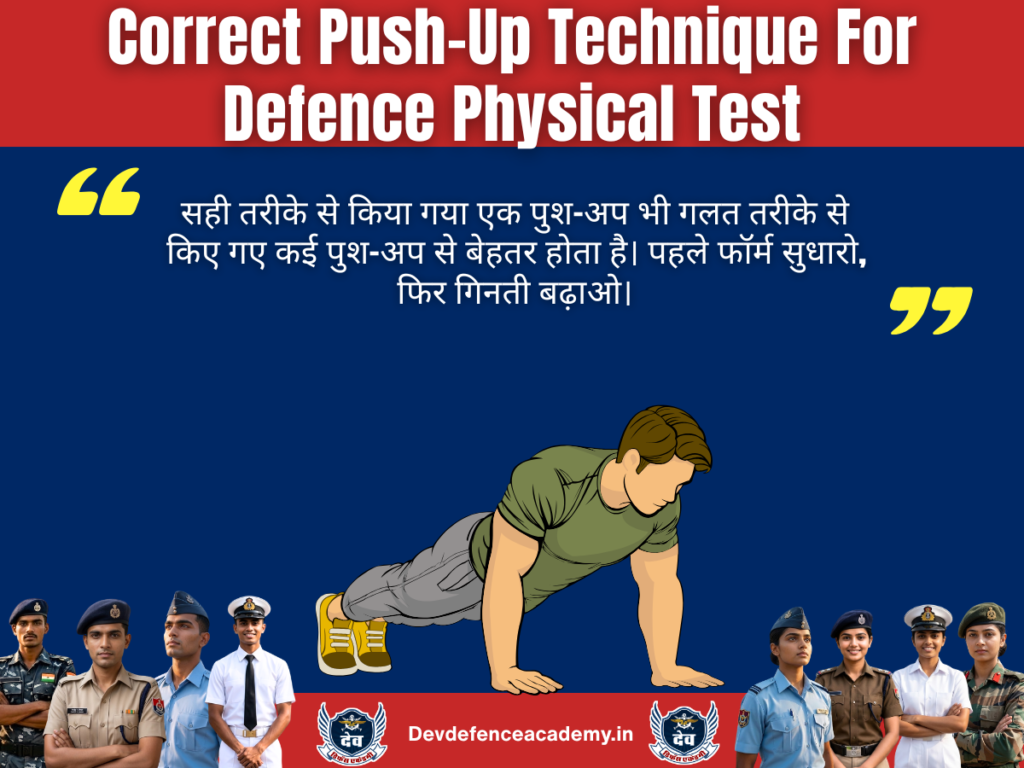
Push-ups look simple, but many students lose marks or energy because their form is poor.
A correct push-up should move the full body as one straight line from head to heel.
Your hands should be slightly wider than shoulder width, and your core should stay tight throughout the movement.
When going down, bend your elbows and lower your chest in a controlled way. Do not let your hips drop or rise too high because this breaks the body line and wastes energy. Come up by pushing the ground firmly without locking your elbows too hard.
Breathing also matters more than most students think. Inhale while going down and exhale while pushing up.
This rhythm keeps your body calm and helps you continue for more reps without feeling breathless too early.
Common Push-Up Mistakes That Reduce Your Count
Many students practice push-ups daily but see very little improvement because they repeat the same mistakes. Half push-ups are the most common problem, where the body does not go down properly.
These reps may increase the number in practice, but they do not build real strength.
Another mistake is spreading the elbows too wide. This puts extra pressure on the shoulders and makes the movement harder.
Keep your elbows at a natural angle so your chest, shoulders, and arms work together.
Some students also train to failure every day. They do maximum reps daily until the body is fully tired, but this does not allow proper recovery.
Improvement happens when training and recovery work together, not when the body is overloaded without rest.
Correct Sit-Up Technique For Defence Physical Test
Sit-ups require more than just abdominal strength. You need rhythm, breathing, hip movement, and control.
Start by lying on your back with knees bent and feet stable. Keep your hands in the required position according to the test rules you are preparing for.
As you rise, use your core to lift your upper body instead of pulling your neck. Many students pull the head forward, which creates neck pain and reduces efficiency.
Your movement should be smooth and controlled from the stomach area.
Exhale while coming up and inhale while going down. This breathing pattern helps you maintain rhythm during timed practice.
If you hold your breath, your body gets tired faster and your count drops.
Common Sit-Up Mistakes Students Should Avoid
One major mistake is doing sit-ups too fast in the beginning. Students try to show speed early, but after 20 or 30 reps their body slows down badly.
A steady rhythm is better than a fast start and weak finish.
Another mistake is using jerky movement. This puts pressure on the lower back and reduces core engagement. Sit-ups should be quick but controlled, especially when you are still building strength.
Many students also ignore stretching for the hip flexors and lower back. Tight muscles can make sit-ups feel harder than they should be.
A few minutes of stretching after practice can improve movement and reduce pain.
7-Day Beginner Routine To Build Push-Ups And Sit-Ups
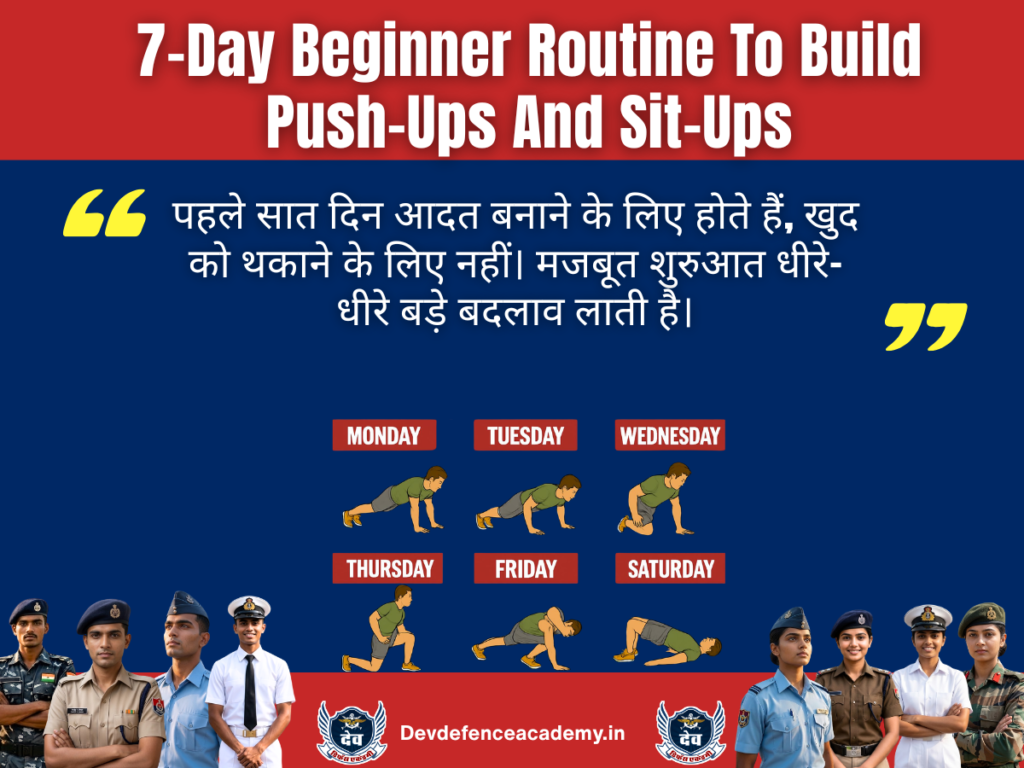
A beginner should not start with heavy volume from day one. The first week should focus on correct form, habit building, and light strength improvement.
This is the foundation for future progress.
On day one, test your maximum push-ups and sit-ups, then do three light sets at around 50 percent of your maximum count.
For example, if your maximum push-up count is 10, do three sets of 5 with proper rest. Do the same with sit-ups.
From day two to day six, practice small sets instead of one big set. Add incline push-ups, knee push-ups, planks, crunches, and light stretching.
On day seven, take an active recovery day with walking, stretching, and light mobility work.
30-Day Plan To Increase Push-Ups And Sit-Ups Count
A 30-day plan gives your body enough time to show real improvement. The first week should focus on form and basic strength.
Do small sets, avoid failure, and learn proper breathing.
The second week should increase total reps. Instead of only doing one maximum set, divide your practice into 4 to 5 sets.
This builds endurance and allows the body to handle more total work.
The third week should include timed practice. Try 30-second and 1-minute sets for both push-ups and sit-ups.
The fourth week should feel more like the actual physical test, where you practice with proper warm-up, fixed timing, and honest counting.
Best Exercises To Improve Push-Up Count
Push-ups improve faster when you train supporting muscles also. Incline push-ups are very useful for beginners because they reduce body weight pressure and help build correct movement.
You can do them using a bench, wall, or stable platform.
Knee push-ups help students who cannot perform full push-ups yet. They build chest, shoulder, and triceps strength without too much load.
Once you can do 15 to 20 knee push-ups easily, slowly shift to full push-ups.
Plank holds are also important because push-ups need a strong core. Start with 20 to 30 seconds and increase slowly.
A stronger core keeps your body straight and prevents your hips from dropping during push-ups.
Best Exercises To Improve Sit-Up Count
Sit-up count improves when your complete core becomes stronger. Crunches are helpful because they activate the upper abdominal muscles.
They are easier than full sit-ups and useful for building early strength.
Leg raises strengthen the lower abdominal area, which many students ignore. Start with small sets and keep your lower back controlled. Do not swing your legs because that reduces the benefit.
Planks and side planks also support sit-up performance. They improve core stability and endurance.
A student with a strong core can maintain sit-up rhythm for a longer time during the physical test.
How To Use Sets And Reps For Faster Progress
Doing one maximum set every day is not the best method. A better approach is to divide your total practice into smaller sets.
This allows you to do more total reps without destroying your form.
For example, if your maximum push-up count is 20, do 5 sets of 10 to 12 reps instead of doing 20 once and stopping.
This gives your muscles more practice and better endurance. The same method works for sit-ups too.
Rest between sets should be enough to recover but not so long that the body cools down. Around 60 to 90 seconds is enough for most students. As you improve, reduce rest slowly and increase total reps step by step.
Importance Of Warm-Up Before Practice
A proper warm-up prepares your body for training and reduces injury risk. Many students directly start push-ups and sit-ups, then complain about shoulder pain, wrist pain, or lower back tightness. Warm-up should never be skipped.
Start with light jogging, arm circles, shoulder rotation, wrist movement, hip rotation, and dynamic stretching. This increases blood flow and prepares muscles for work. Even 8 to 10 minutes of warm-up can make your practice better.
Before sit-ups, activate your core with light crunches or plank holds. Before push-ups, do wall push-ups or slow shoulder movements. Your first set should always feel controlled, not sudden and forced.
Recovery And Diet For Better Physical Performance
Your body becomes stronger during recovery, not only during exercise. If you train hard but sleep poorly, your count may not improve.
Most students need good sleep, enough water, and simple nutritious food to perform better.
Eat a balanced diet with roti, rice, dal, vegetables, fruits, milk, eggs, paneer, or other protein sources according to your food habits.
Avoid heavy oily food before practice because it can make you slow and uncomfortable. Light, energy-giving meals support better training.
Hydration is also important. If your body is dehydrated, your muscles get tired faster. Drink water through the day, not only just before exercise.
Weekly Self-Test Method To Track Improvement
Testing yourself every day can create pressure and disappointment. A better method is to test your maximum count once a week. This gives your body time to adapt and shows more accurate progress.
Choose one fixed day each week for testing. Warm up properly, then perform push-ups and sit-ups with correct form. Note the count in a notebook or phone.
Tracking is important because it shows whether your plan is working. If your count is improving slowly, continue the routine.
If it is not improving at all, check your form, rest, diet, and training volume.
How To Prepare For Timed Push-Ups And Sit-Ups
Many defence physical tests depend on time, so you must practice under time pressure. A student may do 40 push-ups slowly, but may struggle when asked to perform within a limited time. Timed practice develops speed and control together.
Start with 30-second rounds. Do as many clean reps as possible without losing form. After a few days, increase to 1-minute rounds and then practice according to the test pattern you are preparing for.
For sit-ups, rhythm is very important in timed practice. Do not start too fast. Keep a pace that you can maintain until the end, then push harder in the final few seconds.
Test-Day Strategy For Push-Ups And Sit-Ups
Your test-day performance depends on what you do before the test also. Do not do heavy training one day before the physical test. Keep the body fresh with light stretching, walking, and proper rest.
On the morning of the test, eat light and familiar food. Do not try a new supplement or heavy meal. Reach the ground with enough time so you can warm up calmly.
During the test, focus on clean reps and steady breathing. Do not panic by watching other candidates. Your aim is to perform your best count with confidence and control.
When Structured Physical Training Helps Defence Aspirants
Some students improve well with self-practice, but many need supervision because they repeat wrong form without realizing it.
A trainer can correct posture, count honest reps, and design practice according to the student’s level. This becomes useful when a student is stuck at the same count for many weeks.
At Dev Defence Academy, physical preparation is part of a disciplined daily routine along with classroom study and regular practice.
This type of environment can help students who need both fitness guidance and exam preparation under one system.
The academy also provides hostel support, which is useful for students coming from different towns and villages.
Structured training is not only about exercise. It teaches discipline, time management, consistency, and mental toughness.
These qualities matter a lot in defence preparation because selection requires both physical strength and daily commitment.
Practical Weekly Routine For Students
A simple weekly routine can keep your preparation balanced. Practice push-ups and sit-ups four to five days a week, but keep one or two days lighter for recovery.
Add running, stretching, and mobility work so your body remains balanced.
On Monday, Wednesday, and Friday, focus on strength sets. Do push-ups, sit-ups, planks, crunches, and leg raises in controlled volume. On Tuesday and Saturday, do timed practice with shorter but faster sets.
Keep Sunday light with stretching, walking, and recovery. This does not mean you are lazy.
Rest is part of training, and smart students understand that the body needs time to become stronger.
Realistic Timeline For Improvement
A student can usually see small improvement within 10 to 15 days if the practice is regular.
Bigger improvement may take 30 to 60 days depending on current fitness, body weight, diet, sleep, and training quality.
There is no fixed count that improves the same way for everyone.
If your count is very low, your first target should be consistency, not perfection. Move from 5 push-ups to 10, then 15, then 20. Small progress builds confidence and keeps you motivated.
Students who already have a decent count should focus on speed, endurance, and test-like practice.
At this stage, the main challenge is not just doing reps but doing them cleanly under pressure.
Final Preparation Checklist Before Physical Test
In the last week before the test, avoid trying new exercises. Your goal should be to maintain fitness, sharpen rhythm, and keep the body fresh.
Heavy training at the last moment can create soreness and reduce performance.
Check your form once again for both push-ups and sit-ups. Make sure your reps are complete and acceptable according to the test rules.
Practice with someone who can count honestly and correct mistakes.
If you feel confused about your preparation, connect with the academy for proper guidance on physical training and defence exam preparation.
A short conversation with experienced mentors can help you understand where you stand and what you should improve next.
Final Thoughts
How to increase push ups and sit ups count for defence physical test is not about doing random hard work every day.
It is about correct form, planned sets, steady progress, good recovery, and regular self-testing. When these things come together, your count starts improving naturally.
Do not compare your first day with another student’s best day. Every strong candidate begins with a starting point, and discipline slowly turns weakness into strength.
Stay honest with your practice and keep improving one step at a time.
Your physical test preparation should make you stronger, more confident, and more disciplined.
Train with patience, respect your body, and follow a routine that you can continue consistently. That steady effort is what finally shows on the ground.
FAQs
How can I increase push ups and sit ups count for defence physical test?
You can increase your count by practicing with correct form, small sets, and regular progress tracking. Do not try to do maximum reps every day. Train 4 to 5 days a week and give your body proper rest.
How many days are needed to improve push ups and sit ups?
Most students can see small improvement in 10 to 15 days with regular practice. Good improvement usually takes 30 to 60 days. Your result depends on your current fitness, diet, sleep, and training routine.
Should I do push ups and sit ups every day?
You should not do hard push ups and sit ups every day. Your muscles need rest to become stronger. You can practice light form work daily, but keep intense training to 4 or 5 days a week.
What should I do if I cannot do even 10 push ups?
Start with incline push ups or knee push ups first. These exercises build basic strength without too much pressure on your body. Once you become comfortable, slowly move to normal push ups.
How can I improve sit ups fast for defence physical test?
You can improve sit ups fast by training your core with crunches, leg raises, planks, and regular sit-up practice. Keep your movement clean and controlled. Do not pull your neck because it can cause pain and reduce your speed.
What is the best time to practice push ups and sit ups?
Morning is a good time because your body and mind feel fresh after proper sleep. Evening practice is also fine if you have enough energy. The most important thing is to practice at a fixed time daily.
Why is my push-up count not increasing?
Your push-up count may not increase because of poor form, weak core strength, or lack of recovery. Many students also train too hard every day and get tired instead of stronger. Focus on clean reps, proper rest, and slow progress.
Can I increase push ups and sit ups count at home?
Yes, you can increase push ups and sit ups count at home with a disciplined routine. You only need floor space, a timer, and honest tracking. If your form is wrong or progress stops, guided physical training can help.
Which exercises help most for defence physical fitness?
Push ups, sit ups, planks, crunches, leg raises, squats, running, and stretching help most for defence physical fitness. These exercises improve strength, stamina, core power, and body control. They are useful for Army, Police, Paramilitary, and other defence physical tests.
Is coaching helpful for defence physical test preparation?
Yes, coaching can help if you need proper routine, form correction, and discipline. Dev Defence Academy provides physical training with written exam preparation and has 15+ years of experience. This can be useful for students who want a structured defence preparation environment.
What should I eat before push-up and sit-up practice?
Eat light food before practice, such as banana, milk, poha, oats, or roti with simple vegetables. Avoid oily and heavy food before training because it can make you slow. Drink water through the day, but do not drink too much just before exercise.