Rajasthan Police Exam Pattern 2026 has two distinct routes: RPSC conducts the Sub-Inspector examination through two confirmed 200-mark papers, while Rajasthan Police manages Constable recruitment under notification-specific rules.
SI candidates can begin preparation from the published RPSC scheme, but Constable candidates must check their CET eligibility and wait for the relevant Police HQ notification before accepting any claim about questions, marks or PET weightage.
Rajasthan Police Exam Pattern 2026: Complete Guide for Candidates

The recruiting authority depends on the post. RPSC controls the Sub-Inspector and Platoon Commander Combined Competitive Examination, whereas Rajasthan Police conducts direct Constable recruitment for districts and units.
RSSB’s Senior Secondary Level Common Eligibility Test has served as an eligibility gateway for Police Subordinate Service Constable recruitment in recent cycles. It does not replace the subsequent recruitment stages conducted under the police notification.
| Post | Responsible Body | What Candidates Should Check |
|---|---|---|
| Sub-Inspector / Platoon Commander | Rajasthan Public Service Commission | RPSC scheme, Paper I and Paper II syllabi, physical-test instructions and recruitment announcements |
| Constable, including specialised posts | Rajasthan Police, Police HQ or the relevant district/unit recruitment board | CET condition, written-paper scheme, district/unit vacancies, PST, PET and proficiency requirements |
| CET Senior Secondary Level | RSSB | Accepted CET cycle, certificate or score requirement and the cut-off condition in the Constable notification |
The State Recruitment Portal is also used for notifications, admit cards and candidate communications. Applicants should treat the PDF issued for their post and recruitment cycle as the controlling document.
RPSC Sub-Inspector Written Exam Pattern
The official RPSC scheme establishes two objective papers for Sub-Inspector recruitment. Both papers have the same basic question, marks, time and penalty structure, allowing candidates to plan timed practice before the recruitment schedule is announced.
Each paper contains 100 multiple-choice questions for a maximum of 200 marks. Candidates receive two hours per paper, and one-third mark is deducted for every wrong answer.
| Paper | Broad Subject | Questions | Marks | Duration | Negative Marking |
|---|---|---|---|---|---|
| Paper I | Hindi language and related syllabus areas | 100 MCQs | 200 | 2 hours | 1/3 mark per wrong answer |
| Paper II | General Knowledge, General Science and Rajasthan-focused topics | 100 MCQs | 200 | 2 hours | 1/3 mark per wrong answer |
How the Marking Scheme Changes Your Approach
With 100 questions in 120 minutes, average speed matters, but uncontrolled guessing can reduce the net score. Practise in timed 50-question blocks and record whether each mistake came from weak knowledge, careless reading or an unjustified guess.
A sensible omission strategy is more valuable than attempting every doubtful question. During mock analysis, separate confident answers from elimination-based attempts so that you can identify where negative marks are accumulating.
SI Selection Stages
The written examination is followed by the physical stage and then document verification or an interview where applicable under the RPSC announcement. The applicable notification and stage-specific instructions determine the final sequence, qualifying conditions and reporting requirements.
Do not postpone physical preparation until the written result. A candidate who studies both papers well but begins conditioning late may struggle to meet the later physical schedule.
Related Posts
- Rajasthan Police SI Vs Constable Eligibility Salary And Promotion Guide
- Air Force Syllabus 2026: Exam Pattern and Topics
- Navy MR Syllabus 2026: Exam Pattern, PFT and Topics
Rajasthan Police Constable Process: Confirmed Stages and Physical Standards
Constable recruitment is organised by Rajasthan Police for the relevant district or unit. Recent cycles have also required an eligible Senior Secondary CET certificate or score, so CET status should be checked before planning the application.
The broad process is confirmed, but the detailed written-paper scheme and distribution of marks are controlled by the specific recruitment notification. Specialised posts such as Driver, Band or MT may include additional proficiency conditions.
- Meet the notification’s eligibility conditions, including the accepted CET requirement where specified.
- Apply for the relevant Constable post, district or unit.
- Appear for the departmental or Police HQ written examination.
- Complete the Physical Standard Test.
- Complete the Physical Efficiency Test.
- Take any post-specific proficiency test where applicable.
- Attend medical examination and document verification as directed.
Height and Chest Standards
Official Rajasthan Police recruitment guidance cites baseline parameters such as 168 cm height and a minimum chest measurement of 81 cm with expansion as prescribed by the rules. These figures should not be applied blindly to every category or post.
The recruitment PDF may specify category-based, post-based or other permitted variations. Read the physical-standard annexure for your application rather than relying on a general summary.
Details That Still Require the 2026 Notification
The exact number of Constable written questions, total marks, duration and division of marks between different stages cannot be stated as one universal 2026 pattern from the currently validated official material. Exact dates, PET scoring, proficiency marks and sports or NCC treatment also depend on the relevant Police HQ notification.
This is why different websites may display different Constable patterns: they may be describing separate years, posts or annexures. Use the official PDF issued for your district, unit and post as the final authority.
How to Prepare for the Written and Physical Stages Together

SI preparation should centre on the RPSC Paper I and Paper II syllabi, timed MCQs and penalty-aware decision-making. Constable candidates should first secure or verify the required CET record, then map their written preparation to the police notification as soon as it is released.
Written study and physical conditioning need parallel schedules because they are assessed at different stages but can each end a candidate’s progress. Three or four planned running sessions are more useful than occasional exhausting workouts that interrupt study and recovery.
- For SI: Divide study time between Hindi, General Knowledge, General Science and Rajasthan-specific topics, followed by timed objective practice.
- For Constable: Revise Senior Secondary-level fundamentals for CET-related readiness and shift to the exact police syllabus once published.
- For accuracy: Complete OMR-style practice and calculate the score after applying negative marking rather than counting correct answers alone.
- For physical readiness: Build basic endurance first, then add intervals, sprint work and event-specific drills stated in the applicable PET scheme.
- For recovery: Include rest, mobility work and gradual increases in training load instead of making sudden jumps in running volume.
Dev Defence Academy provides Sikar-based, in-person written preparation, physical training where relevant, regular tests and personal guidance. Its disciplined routine can help candidates keep syllabus work, mock analysis and physical sessions moving together rather than preparing for one stage at the expense of another.
A Realistic 12-Week Preparation Plan
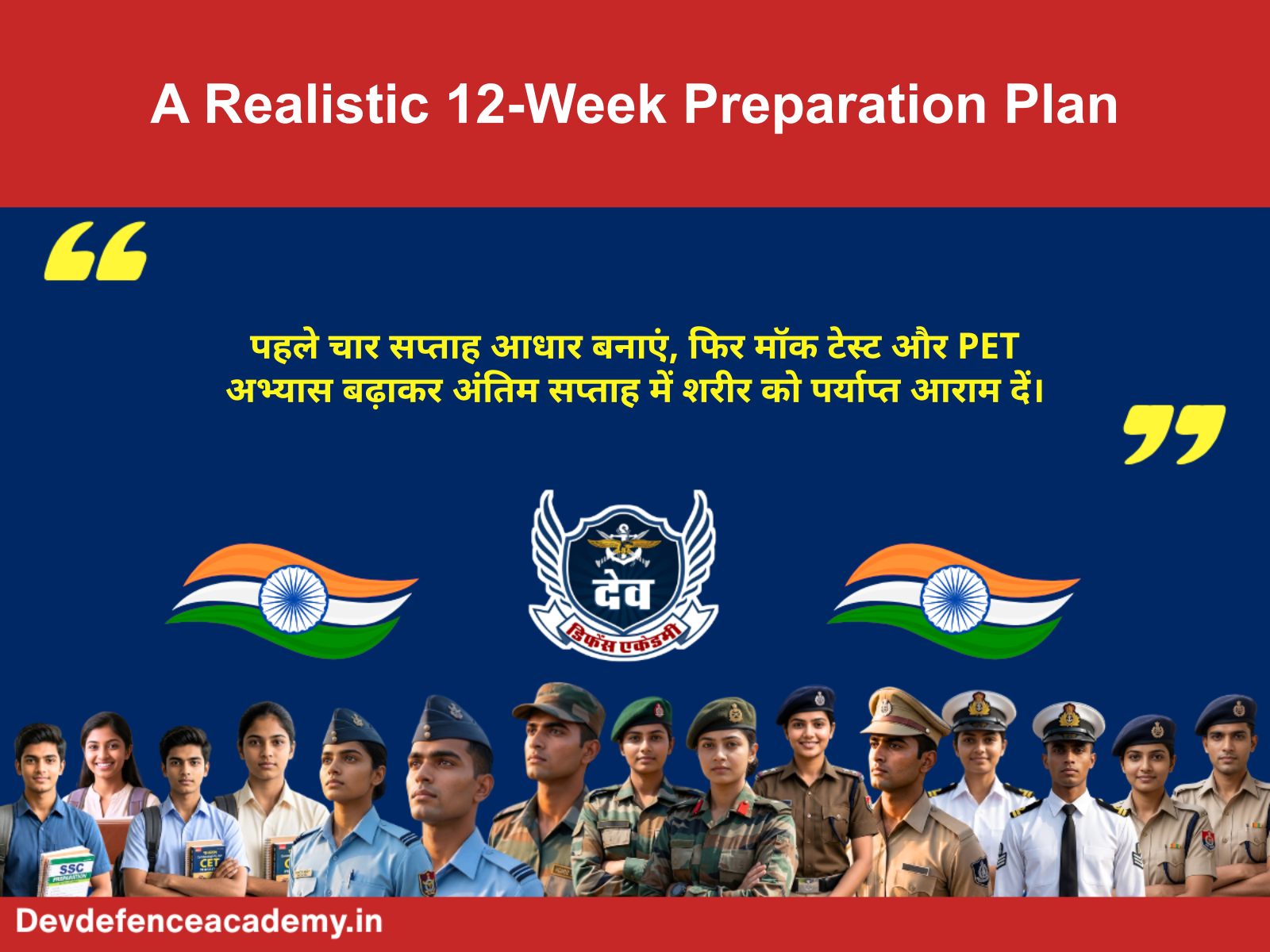
Twelve weeks is enough to build a structured routine, but it is not a promise of selection or a substitute for earlier preparation. Adjust the workload to your starting level, health and the time remaining before the actual test.
The aim is to establish fundamentals first, add exam pressure gradually and taper physical work near the reporting date. Candidates with low current fitness should progress conservatively rather than copying an advanced runner’s schedule.
Weeks 1–4: Diagnose and Build the Base
- Take a diagnostic written test and list weak subjects.
- Download the applicable syllabus and map every topic.
- Check the accepted CET condition and retain the relevant certificate or score record.
- Study for 60–90 minutes daily, focusing on Hindi and GK for SI or Senior Secondary-level basics for Constable.
- Complete three or four easy running sessions each week, beginning with manageable 20–30 minute efforts.
Weeks 5–8: Increase Speed and Specificity
- Begin timed sectional MCQ tests and detailed error analysis.
- Complete at least two full written mock papers during this phase.
- Add controlled intervals or sprint sessions to the running schedule.
- Practise the event-specific technique required by the applicable PET instructions.
- Keep one recovery day after demanding physical work.
Weeks 9–11: Simulate Selection Conditions
- Attempt three full OMR-style mocks per week where practical.
- Apply the official negative-marking rule while calculating SI mock scores.
- Run full PET simulations under measured conditions without adding unverified events.
- Arrange the documents listed in the recruitment notification.
- Conduct a basic medical and physical-readiness self-check before reporting.
Week 12: Revise and Taper
- Revise error notes and high-priority facts instead of opening large new topics.
- Reduce physical volume while retaining short, controlled sessions.
- Check the admit card, reporting time, venue, identity requirements and travel plan.
- Prioritise sleep and recovery during the final days.
At Dev Defence Academy, regular tests and personal guidance can help candidates turn this timeline into a consistent Sikar-based preparation routine. The schedule remains most effective when each mock result leads to a specific correction in the next week.
Common Mistakes That Cost Candidates Progress
Most avoidable problems begin before the examination hall: an unread notification, an unchecked CET condition or physical preparation that starts too late. These mistakes can make months of written study irrelevant at a later stage.
A weekly administrative check is enough to control most of these risks. Keep the official PDF, application record, CET details and preparation log together.
- Missing the CET condition: Assuming CET is optional or that an earlier certificate automatically qualifies can prevent a Constable application from being accepted.
- Using an outdated Constable pattern: Preparing from a previous cycle’s marks distribution may lead to the wrong allocation of study time.
- Ignoring negative marking: Reckless guessing in SI mocks creates an inflated sense of readiness until the penalty is applied.
- Delaying PET preparation: Building endurance and technique takes time; last-minute intense training also raises fatigue and injury risk.
- Skipping district or unit annexures: Candidates may miss post-specific conditions, proficiency stages or reporting instructions.
- Studying without test analysis: Repeated mocks have limited value if the same factual, reading and guessing errors continue.
How to Verify the Official Notification
Use the RPSC website for Sub-Inspector scheme, syllabus and recruitment announcements. For Constable recruitment, check Rajasthan Police recruitment notices and the Rajasthan State Recruitment Portal, while CET documents should be checked through RSSB.
Do not stop at the first page of a notification. The decisive information is often contained in annexures covering physical standards, stage-wise marks, documents and specialised-post requirements.
- Confirm the recruiting body and exact post name printed on the PDF.
- Check the publication date, application window and relevant cut-off dates.
- Read the eligibility and CET clauses rather than relying on a short notice.
- Locate the written-exam scheme, syllabus and negative-marking instructions.
- Read the PST, PET and proficiency annexures applicable to your category and post.
- Note the document list, admit-card process and official grievance contact.
- Return to the official portal for corrections, revised schedules or admit-card updates.
Dev Defence Academy helps students prepare around the applicable syllabus through regular tests and personal guidance in Sikar. Candidates should still retain the official notification themselves because it governs their individual application, category and post.
FAQs
Who conducts Rajasthan Police SI and Constable recruitment in 2026?
RPSC conducts the Sub-Inspector and Platoon Commander examination, while Rajasthan Police manages direct Constable recruitment for the relevant districts and units; RSSB administers the CET used as an eligibility gateway in recent Constable cycles.
What is the confirmed RPSC SI written-exam format?
There are two objective papers, each containing 100 MCQs for 200 marks with a duration of two hours.
Is there negative marking in the SI examination?
Yes. The published RPSC scheme states that one-third mark is deducted for each wrong answer in both papers.
Is CET required for Rajasthan Police Constable 2026?
Senior Secondary CET has been required as an eligibility gateway in recent Constable recruitments, but candidates must check which CET cycle and certificate conditions are accepted in the specific 2026 notification.
What are the Constable height, chest and PET requirements?
Official guidance cites baseline figures such as 168 cm height and 81 cm minimum chest with prescribed expansion, while category exceptions and exact PET events must be taken from the applicable recruitment annexure.
Where will the official 2026 notification appear?
Check the RPSC website for SI recruitment and the Rajasthan Police recruitment pages or State Recruitment Portal for Constable notices, admit cards and candidate updates.
Which documents are required during verification?
Use the notification’s document checklist, including the required CET record where applicable, and carry originals or copies exactly as instructed rather than following a generic list.
Are sports, NCC or proficiency points part of Constable marks?
The treatment of sports, NCC and proficiency marks depends on the post and notification, so no universal 2026 weightage should be assumed before reading the relevant annexure.
How can I prepare for the written examination and PET together?
Use daily written-study blocks, three or four progressive physical sessions per week, timed mocks and periodic PET simulations, with recovery days built into the schedule.
Why do websites show different Constable marks and weightages?
They may be referring to different recruitment years, districts or specialised posts; only the official PDF for your recruitment cycle, unit and post should determine your exam plan.
Final Thoughts
The confirmed Rajasthan Police Exam Pattern 2026 gives SI candidates a clear starting point: two 100-question, 200-mark RPSC papers with two hours per paper and one-third negative marking.
Constable candidates should verify the accepted CET requirement first, then copy the written scheme, physical standards and stage weightage directly from the relevant Police HQ notification. Keep written practice and physical preparation running in parallel.
If you want a disciplined routine with regular tests, written preparation, relevant physical training and personal guidance, you can connect with Dev Defence Academy in Sikar, Rajasthan.